Showing posts with label Vik. Show all posts

Tuesday, August 14, 2012

Kristoffer Kristenson abt 1610 - 1710

Kristoffer Kristenson married Ase Amundsdotter and they lived on the Le (or Lee) Farm. They are our GGGGGGG Grandparents.

I have some time and I have been going over old emails from Wilda Obey from last year. I have been saving these emails to add the information once I had all the basic family tree information input into the database and organized and checked. Bit by bit, I hope to add the relevant information to the database and to the blog for everyone to share in. 


Kristoffer Kristenson and Ase Amundsdotter lived on Le Farm which is in Arnafjord of Vik in the Vik Bygdebok. 

All 3 farms where are relatives lived over the years are in Vik. Vangsnes is a peninsula near the main part of Vik, which is called Vik, Vik. Vangsnes is now the main ferry terminal to cross the Sognefjord from Vik to Balestrand and Leikanger. It is a very large farm with many sub farms = many different families living there. Le and Nistad are in the Arnafjord part of Vik. This is a remote, mountainous, beautiful area with small farms with only one or a few families living at each farm. However Lie/Lee is a very common name, meaning meadow or pasture, and possibly the Lee in question is a sub farm of a larger farm.

Bygdbok is bok = book and bygd= a rural community. These books list all of the farms in one area of Norway by farm. They usually start at about 1600 and mention the name of the farmers there then. They mention his wife and children and usually give some dates, by year only. They tell where the children went or who they married if they left the farm. It continues on with who lived at the farm down to the early 1900s. The bygdebok doesn't list exact dates, and sometimes doesn't list all children.
Page 206 of the Vik i Sogn bygdabok has the Le farm (in Arnafjord) and says something like:

After the black death the church at Flete owned part of Le and the pastor the other part, and there may have been other owners. The first farmer here that I know of is Johannes in 1603, then Lasse in 1611 and 1620s; in 1645 there were 2 farmers here: Kristoffer Kristofferson with wife Asa Amundsdatter, and Ivar with wife Dorte Knutsdotter.
(That was more or less my a translation with my self taught Norwegian. Note it has Kristofferson in this paragraph but the next paragraph has Kristenson. WO)
Le farm #1: on this farm in 1645 has Kristoffer Kristenson and he was here until 1701. He was born in 1610.
He had many sons, but I don't know of all of them:
Kristen went to Dalsvaer,
Gunnar had a part of Le for a time;
Sjur died unmarried;
Hans got the farm after his father;
Amund got farm 2 on Le. 
(This is what the author is saying. Next is something about these brothers, but I don't quite understand it. I think it may say these brothers weren't getting along with each other. If you printed this page from the bygdabok, perhaps you could get someone from Sons of Norway - in Indiana or MN that is, to read it for you. 
Bygdebok/bygdaboks are in many libraries in the U.S. You can get lists online. In MN St. Olaf College in Northfield has a very large collection. U of MN in the Twin Cities has some. LDS library in Salt Lake City has some, U of ND ak (or is it ND State - the northern one, the one not in Fargo) has many. Perhaps in IN the Fort Wayne library might have some. I have no idea.WO)
Note: Our family tree database does not include someone named Amund as a child of Kristoffer Kristenson. One more thing to check out. But the children's mother is Ase Amundsdotter, so Amund could be her father or a child we do know now about who was named after her father.

Wednesday, September 21, 2011

The Early 1800's - More about the Times


I have often wondered why so many people left Norway at this time. My brother even said after looking at the beautiful photos of their farms, Why would people leave such a beautiful place? Why, indeed?

Wikipedia says:
...Between 1396 and 1536 Norway was a part of the Kalmar Union, and from 1536 to 1814 Norway was effectually a tributary to Denmark, and was called Denmark-Norway. Denmark–Norway entered into an alliance with Napoleon, with the war leading to dire conditions and mass starvation in 1812....
In the Vik area --
On December 2nd 1811 there was a landslide in Arnafjorden in Nese which devastated the area. Forty-five people were killed. The farm buildings in Nese were all gathered together in one place, just where the landslide happened. Then, in 1812, crops were very bad. People had to work very hard just to get by. They needed help, but it was hard to get help. Even by around 1830 or so, people had still not fully recovered from the hard times. 

In 1839, the first people left Vik for America. They were Per Ivarson Undi and his wife and children. They were the first emigrants from the Sogn og Fjordane County and they were the start of a flood of people leaving the area. Looking at the villages in and around Vik, more than 4,000 people left Vik. Now, there are only about 2,700 people in Vik, but there are thousands of Americans with roots in Vik i Sogn.

And then there were hard social conditions. They did not exactly have serfdom in Norway, but something similar.

Norwegian serfdom can be a way of defining the position of the Norwegian lower class farmers, though they were not actually in serfdom by European standards. The evolution of this social system began about 1750.

The system of Norwegian inheritance was based on a paternal line. Usually the younger sons got a share of the original farm, thus splitting it up in smaller homesteads. In the eastern parts of the country, and to some extent the mountain municipalities, the smaller homesteads still belonged to the main farm, and the lesser farmers were obliged to work the fields on the main farm as well as their own, in exchange for living there. This could lay heavy burdens on the smaller homesteads.


Vik Coat of Arms*
Sogn og Fjordane
As time passed, the smaller homesteads passed from farmer to farmer, and the actual bonds between the families could be broken. In Hedmark, a main farm could govern up to ten smaller homesteads, spread around in the forests and fields connected to the farm. Social exploitation could often be a result of this policy, and also a strict social order, not to be broken (described in some of the novels of Bjørnstjerne Bjørnson, and later Ingeborg Refling Hagen and Alf Prøysen). The difference from serfs elsewhere was that the farmer did not directly own the life and property of the homesteader (Husmann), but in most cases, he practically did. In Hallingdal this was most common in the lower parts of the valley, and, at some point, all the serfs were evicted, and the homesteads torn down. Many of the Norwegian migrants to America came from this social class. So did also the main stock of Norwegian workers, as the land got crowded and the shifting of land came to an end about 1860.

Vik within Sogn og Fjordane
Could the landslide and subsequent bad economic times along with Ivar's parents deaths in 1850 have pushed him into going to America to better himself? Since 1839, people had started to leave. He must have heard the stories of abundant land to be had to any hard working family.  And in his position of being the 4th son in a large family, he would have expected to get little after his parents deaths. And with their deaths in 1850, it must have been very clear to him what he could expect.

*The coat of arms, granted on March 15, 1991 shows 3 knives for cutting leaves used for fodder.

Thursday, September 15, 2011

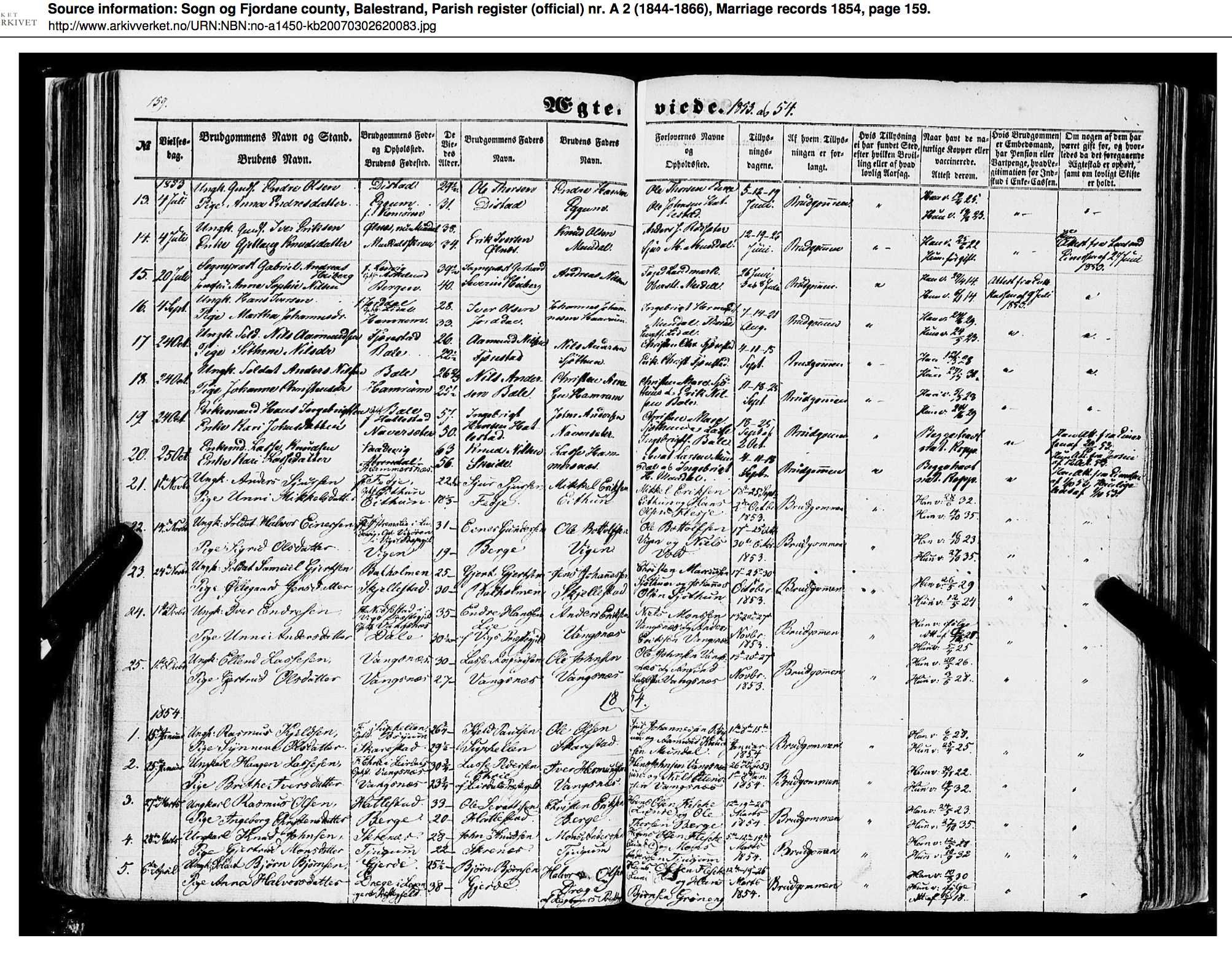
Iver Endreson & Unni Andersdattor Marriage

Wilda Obey searched the Balestrand bygdebok, read the Norwegian and found the following:

Sogn og Fjordane county, Balestrand, Parish register (official) nr. 
A 2 (1844-1866), Marriage records 1854, page 159.

Background information
Vangsnes is now in the Vik administration unit and it is part of the Vik mainland. In the past Vansnes was considered part of Balestrand Parish which is across the Sognefjord. In the days before roads were built, it was easier for government and church officials to go across the fjord by boat than to hike over the mountains. Thus, the Vangsness farm is in the Balestrand bygdebok.

On Find a Grave, we have photos of John E's grave stone listing his birth as July 13th, but the Balestrand church book (1844-1866) lists his birth as July 12th, 1852. (see my blog entry John E. Vangsness' Birth Records.) His parents were not married at the time but they did marry in December 1853. They went to America in 1854, most likely in April. We are a little puzzled about the two birth dates being different. One would think that John E. would know his own birthday! But we have been told that mistakes do happen on gravestones....

John was born at the Vangsnes farm. His father was Iver Endreson Nissestad and his mother was Unni Andersdatter Vangsnes. At their marriage, Iver is 35 and Unni is 30 years 6 months.


Marriage Records  http://www.arkivverket.no/
Detail
See Item No. 24
Explanation
  • No: 24
  • Date: either December 1st or 17 (hard to read), 1853
  • Brudgommen's Nave (Bridegroom's Name) Ungkari = bachelor Iver Endreson, Oppholdssted (Residence) next possibly that he was born in Nissestad in Vig (Vik) and possibly saying he is now residing in Vangsnæs. Age 35. Brudgommens Far: His father is Endre Hansen Lie; 
  • Bruden’s Navn (Bride's name) Pige = unmarried woman or girl Unni Andersdtr, Oppholdssted (Residence) from Dale, Age 30 1/2. Bruden’s Far: Her father is Anders Erikson Vangsnæs.
  • Forlovernes (witnesses or best men or Sponsors) are Niels Monsen Vangsnæs and Anders Eriksen Vangsnæs. (Anders is most likely her father, so Niels would be a friend or relative of the groom.)
  • Tillysningsdagen (date of the wedding announcement): The next column could be the dates for the 3 banns dates where the marriage has to be announced in advance. The dates are hard to read.
  • Naar Havt De Naturlig Koppar, Eller Vaccineret? Attest Derom (Have they had smallpox naturally, or if not, have they been vaccinated? Attest thereto): Answer: yes. * Iver's is hard to read, ???, 1827 and Unni's is 5/4 25, meaning most likely 5 April 1825.
*I will write about this later, but small pox etc. was a big problem. In the early 1800s everyone had to be vaccinated before marriage.

Click here to see an enlargeable version of the page.

A reminder of where the farms are:
Unni's home farm is not shown on any of the maps I have put on the blog:: New Map of Vik and Area. But look at the map with Vik at the south edge with Balestrand across the fjord. You can see Vangsnes and the ferry routes. The Berge farm in Balestrand is further north. Follow the ferry route north along the bit of the fjord called Fjaerlandsfjord. Wilda Obey says that the farm is close to Mundal where US Vice President and ambassador to Japan Walter Mondale had ancestors.

The second map shows the southern part of Vik. There you can find the Le or Lee farm and the Nissestad farms.

Wednesday, September 14, 2011

John E. Vangsness' Birth Records

Sogn og Fjordane county, Balestrand, Parish register (official) nr. 
A 2 (1844-1866), Birth and baptism records 1852, page 21.
The actual Parish register, p 21, Arkivverket Risksarkivet Og Statsarkivene

Detail

Our ancestor, John E. Vangsness' birth record in Norway.
Click on the image to see a larger version. Most browsers will allow you to zoom in at least one level or enlargement. Use the back arrow in your browser to get back here.
He is No. 39.
--Or click here for a PDF version which can be enlarged.

  1. Birth date: 13 July
  2. Baptism date: 18 July
  3. Name: John
  4. Whether Legitimate or not: He is not. But, underneath it mentions that his parents married in 1853.
  5. Parent's names: Ungkari / bachelor- Iver Endreson, Pige / unmarried woman or girl - Unni Andersd. Vangsneas
  6. Sponsors:  Viking Endresen Nissestad (obviously his father's brother listed as Wiking on John G.'s family tree records) and his other 4 sponsors all live at Vangsnes.
  7. Note about being illegitimate: It has Erik (something like Pe) derson Vangsneaes. It could be that Erik Anderson Vangsnaes could be the babies grandfather. He may be vouching for the couple. (The ae in that name looks like an o.)

About Baptismal Records
-For baptismal records the year usually will be written at the top of the page.
-The left hand column is the chronological number of that baptism for that year, starting with #1. 
-Usually the next column will be the birth date, and the next column is the baptism date, then the child's name, next whether it is a legitimate birth, next the parents' names and residence. 
-Next, usually on the second page, are the baptism sponsors, often 5 in number, with the oldest or most important man listed first, then the other men, and then the women. 
-There may be a column for stating if there was a home baptism and by whom. 
-There may be a last column for remarks, such as explaining why the parents aren't married. 
-Some baptism records separate the boys from the girls, either with the boys on the left page and the girls on the right, or with the boys at the top of the page and girls at the bottom.

If you can't tell by the name the sex of the child; a boy usually has 3 male sponsors and 2 female, while a girl has 3 female sponsors and 2 males. Almost always the male sponsors are listed first, oldest or more important first, and then the youngest, often the last is newly confirmed = circa age 16.)

Thank you to Wilda Obey for finding this material and sharing it with us AND translating the Norwegian. AND for her detailed instructions on how to find the correct page in the Parish Records so that I could download it.

Tuesday, September 13, 2011

Bygdaboks

What are Bygdaboks
We are receiving help in looking for our relatives from Wilda Obey, a member of the Genealogical Society in her part of Minnesota. She has 3 bygdeboks for the Sognefjord area of Norway; Leikanger Vik and Balestrand. She was first in contact with Dave Vangsness and I was able to contact her with Dave's help. She has copies of several other important resources from the Vik area.

Thank you so much, Wilda!!

Wilda Obey says:

Bygdbok is bok = book and bygd = a rural community.

These books list all of the farms in one area of Norway, by farm. They usually start at about 1600 and mention the name of the farmers there then. They mention his wife and children and usually give some dates, by year only. They tell where the children went or who they married if they left the farm. It continues on with who lived at the farm down to the early 1900s.

Arkivvet is the Norwegian spelling of archive. (That is v v not w) This is online and has actual church pages and these are of baptisms, marriages, burials and also vaccination, confirmation, and those coming into and leaving the parish. It also has some censuses, not the actual page, but a transcription, and emigration information.

Names
Our first ancestor to come to America is named Iver Endreson, Nistad, his wife is Unni Andersdattor.

Wilda always tell everyone not to worry about spelling. There are several different ways to spell almost every personal name and the farm names. In Norway a child was usually named for a grandparent, sibling of the parents or first spouse who had died of either parent.

The patronym, Endreson, means he is the son of Endre. Endre's daughters would be Endresdatter, and they kept this name for life, as even after marriage, they are still Endre's daughter. The last name, Vangsnes, Lie, Nistad is the farm name. This should be thought of more as an address than as a permanent name. 

Iver/Ivar Endreson may have been born at Nistad, married and lived at Lie/Lee/Le (which is the Le in Arnafjord, Vik) and then moved to Vangsnes and taken that name. 

In the U.S. they could use the farm name, or the patronym, usually choosing a name that Yanks could pronounce and not make fun of. Or they might take a more Anglicized name, often starting with the same first letter as the original name.

Monday, September 12, 2011

Fridtjof the Bold

The Frithjof's Saga

File:Statue av Fridtjov den frøkne oppført av Vilhelm II.jpg
Fridtjof the Bold              Photo By: Ssolbergj
In Vik, Vangsnes, there is a small peninsula or point where this statue is located. This is Fridtjof, the Bold from The Frithjof Saga.

Friðþjófs saga hins frœkna (Frithiof's Saga) is a legendary saga from Iceland which in its present form is from ca 1300. It is a continuation from The Saga of Thorstein Víkingsson (Þorsteins saga Víkingssonar). It takes place principally in the Vik area of Norway during the 8th century.

Shelly Sylvester summarized the story something like this:

This big fellow is a local viking hero. He wanted to marry Ingebjørg, the daughter of King Bele from the other side of the fjord where Fridtjof lived (Vangsnes).

Fridtjof and Ingebjørg grew up together on the farm Hilding (one of the largest farms in Sogn at the time, situated further in the fjord). But when Fridtjof wanted to marry Ingebjørn her brothers tried to put a stop to it, because they wanted her to marry the powerful King Ring of Ringerike (east Norway), to avoid a big war with him. To make this happen the brothers sent Fridtjof on a trip to the Orkney islands telling him to collect taxes and hoping to be rid of him for good. Then they made Ingebjørg marry King Ring and robbed and burned Fridtjof's home farm on Vangsnes.

When Fridjof came back and saw what had happened to his home farm and Ingebjørg he burned the Grand farm that Ingebjørgs brothers lived on in Balestrand, and stole back the ring he had given to Ingebjørg before he left on the mission her brothers cooked up. Now he was lawless and left to raid foreign countries for treasures - that is to say, he went on Viking Raids!! After 3 years on the run he returned to Ringerike making himself out to be an old man that wanted to see his old girlfriend Ingebjørg. The old King liked Fridtjof and promised that he could have Ingebjørg as his own wife when the old king passed away to stop him going on another raid. Soon after the old King died.

Fridtjof took Ingebjørg as his wife and controlled the kingdom until the old king's sons where of age. They didn't like Fridtjof so they went to war against him. In one battle Fridtjof killed one of the sons while the other begged for his life and Fridtjof let him live. After this Fridtjof became King of all of Sogn and made Hordaland part of his kingdom too.
What is a SAGA

According to Wikipedia:
The setting is primarily Scandinavia, but occasionally it moves temporarily to more distant and exotic locations. There are also very often mythological elements, such as dwarfs, elves, giants and magic. In centuries past, they were considered to be reliable historic sources by Scandinavian scholars, but since the 19th century, they have been considered to contain very little historic material. The present consensus is that, although some of the sagas contain a small core which is not fiction, or are based on historical characters, the primary function of the legendary sagas was entertainment, and the aim of the sagas has not been to present a historically accurate tale. Recently, however, it has been emphasized that the sagas are useful sources for the culture of 13th and 14th century Iceland, "in terms of the light that they can shed on the culture in which they were composed" i.e. Iceland in the later Middle Ages.

The statue in the picture was given to the county of Vik in 1913 by the German Emperor Wilhelm II. The statue of Fridtjof the Bold stands 22.5 m tall and it located on Vangsnes Point.

New Map of Vik and Area

If you click on the maps, I believe they will open in your browser and one more click will enlarge it. These two maps show all the farms in the Vik - Sognafjord area.

Wilda Obey says:
The Map #1 with Vik at the south edge and Balestrand across - shows Vangsnes and its ferry routes. The Berge farm in Balestrand is further north and not on this map page. It is on the Fjaerlandsfjord and is fairly close to Mundal where U. S. VP and ambassador to Japan Walter Mondale had ancestors.

The Map #2 is of the southern part of Vik and shows the Lee (here spelled Lee but it must be your Le) and Nissestad farms.

Map #1
Kartbok for Vest Landet Copyright Bergens Tidende, 1985
Click here for PDF version of Map #1 that can be enlarged to see farms more clearly.

Map #2
Kartbok for Vest Landet Copyright Bergens Tidende, 1985
Click here for a PDF version of Map #2 that can be enlarged to see farms more clearly.

A Little Bit About Vangsness

The Ploughshare
Vik
Vangsnes is a village in the parish of Vik, Sogn go Fjordane County.

The Vikjavev Home Page says:
Vangsnes most likely got it name from Vangsen, "The Ploughshare", a sunken rock in the fjord off Vangsnes. "Nes" means "point".

This home page is really beautiful, with lots of photos and daily weather-of-the-day photos of Vik, listings and photos of the farms and much interesting information.
http://vikjavev.no/

If you jump to the Vikjavey Home Page, they have a photo updated daily showing Vangsness. There is also a clickable map with photos of farms.

History link. Go to Vik i Sogn though the centuries to read a short history of Vik

Long ago, there were 3 distinct areas where people lived in Vangsnes:
  • Indreneset,
  • Midtun,
  • Ytreneset.
It seems in Norway at the time, there were summer farms and winter farms.
Norway farms.jpg
The summer farms that were part of Vangsness district are:
  • Kallbakk,
  • Kleivadalen,
  • Endresete,
  • Godstol and
  • Gjelet

Notice one of the farms is called Endresete, which is close of some of the names found among our ancestors: Endre...

Originally, up to 1837, Vangsnes was in Leikanger parish.
In 1850, Balestrand was established and Vangsness was transferred there.
The last and most recent governmental change came in 1964, when Vangsnes was transferred to Vik parish.

Saturday, September 10, 2011

Borgund Stave Church

My sister, Nella Synneve Parrish, and her husband, Mike, visited Norway and Vik a couple of years ago. This church is considered one of the best and most complete examples of its kind.

Nella in front of Borgund Stave Church

Thursday, September 8, 2011

Map of Norway - Sognafjord, Arnafjord

Please take a look at this map provided by Dave Vangsness.
It is a scan of an old atlas that he has.

I added the red arrows showing 4 interesting sites:

  • Sognafjord - the name of fjord where they lived.
  • Vangsnes Farm - which is now a ferry landing.
  • Arnafjord - where the Lee/Le/Lie Farm could be.
  • Borgund Stave Church


Below, where it says Location, I had also added a Google Map, so you can zoom in and out to see more of the country.

Thursday, August 25, 2011

Where they came From

Iver E. Vangsness and his wife Unni left Vik, Sogning Norway (Sognafjorden) in 1854.

John Vangsness II and his wife Jerry in the early 1990's visited Norway looking for information about their relatives. They originally looked for a town named Vangsness or people named Vangsness. But they were having no luck.

In Vik they met a woman named, Anna Nummedal, who gave them information where to find their relatives who are mostly called "Lee" in Norway as their relatives came from the Lee farm. We have many second cousins named Lee in Norway.

John and Jerry found the original Lee farm house and other old structures that stood on the steep banks of a fjord. They found the actual house where Iver E. Vangsness was born.

Vik, Sogning, Norway - Vangsness Home

Their guide said that the closest building was 200 years old and that the Vangsness home was even older.

John and Jerry purchased a wooden bowl painted by Anna and a book of statistics about people who had moved to the States from the Vik area. Many, many people in Vik had moved to Kenyon and Goodhue County and other places close by.

They stayed an extra day in Vik and found out many interesting things about the Vangsness family. "That will be the next chapter in the story of the Vangsness trip to Norway,...." said the newspaper article.  Sad to say, the article ends there. I do not have the next chapter, even if there was one.

(From information provided by John G. Vangseness in 1996.)